Influence, Not Authority: Leading SocialTalent’s Biggest Product Launch

Role: Product Lead, from design through beta to commercial launch Scale: The biggest and most collaborative project of my career so far, spanning every function in the company, none of which reported to me
Timeline: Design began early 2025, GTM enablement in late 2025, market announcement and sales begin in early 2026.
The problem
Companies invest enormously in attracting talent, then leave the moment that decides everything, the interview itself, almost entirely to chance. Hiring outcomes depend on which manager happens to conduct the interview. The best interviewers ask sharp, structured, legally sound questions; everyone else improvises, staring at a resume five minutes before the call. Candidates get wildly inconsistent experiences, feedback arrives late and vague, and organisations carry real compliance risk without knowing it.
Our thesis: interview quality shouldn’t be a lottery. AI could give every interviewer the preparation, structure, and feedback that only the best interviewers naturally have.
Meet Cara
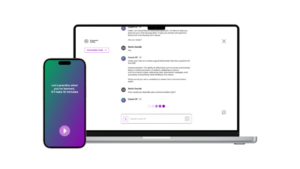
Cara is SocialTalent’s artificial intelligence based on real human expertise. She isn’t just the name and face of our AI, she’s the embodiment of SocialTalent’s 15 years of industry knowledge, and she powers our AI agents to not just complete tasks, but bring expert hiring judgement to every decision a hiring team makes.

That grounding was a deliberate product choice, and our real differentiator. Any competitor can call the same models we can. What they can’t replicate is a decade and a half of expert hiring methodology shaping every plan, question, and piece of feedback the AI produces. Generic AI gives you plausible answers while Cara gives you the answer a world-class hiring expert would.
Scoping v1: the discipline of saying no
Interview intelligence is a huge product surface. Before, during, and after every interview there are opportunities to add value, and just as many opportunities for scope creep. My most important early work was defining exactly what v1 included, and holding that line so we could expand from evidence rather than instinct.
The clearest example was integrations. Every customer works in a different stack, and we could have spent a year chasing coverage. Instead we picked three: Microsoft Teams, because that’s where most of our enterprise customers actually conduct interviews, and Workday and SmartRecruiters, two of the most widely adopted ATSs. Deep integration with the tools our customers already trusted beat shallow integration with everything.
What we built
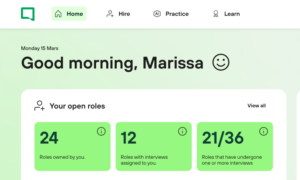
The platform supports the full arc of an interview. Before the call, AI builds a structured, role-specific interview plan in seconds, aligned to the competencies that predict performance, with compliance guardrails flagging legally risky questions. The interview itself is recorded and transcribed. Afterwards, AI summarises what actually happened, evaluates how well the interviewer covered the plan, and produces structured, comparable feedback instead of “seemed nice.”


From API call to agent platform
We launched development with a direct API integration into OpenAI. It got us moving fast, but we quickly hit its limits: a product this broad needs orchestration, observability, and quality guarantees that a single API call can’t provide.
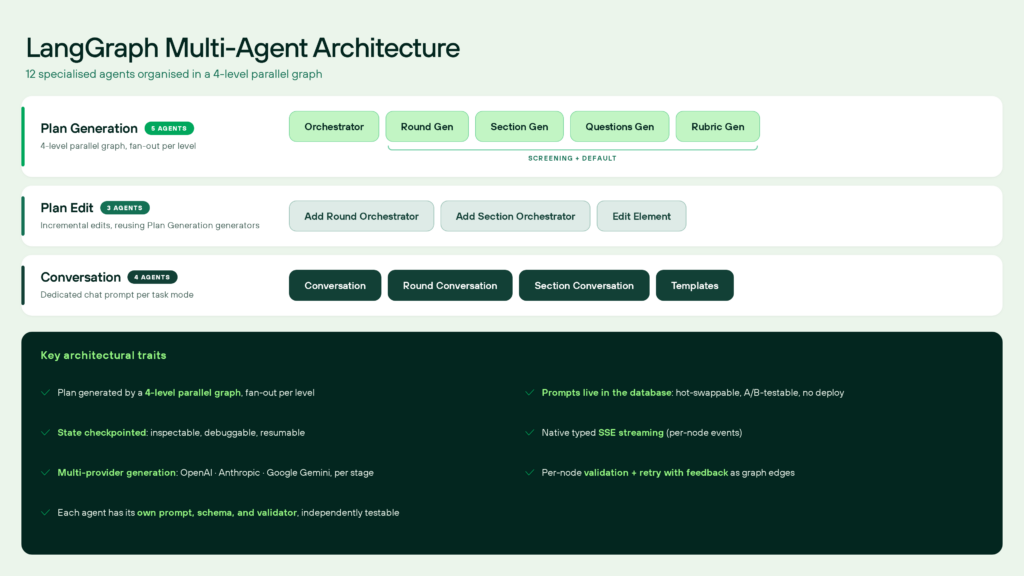
So we rebuilt on LangChain as a full multi-agent architecture, 12 specialised agents, each with eval coverage to ensure reliable functioning across the platform. That evaluation layer mattered as much as the agents themselves. When your product is advising hiring managers on real hiring decisions, “usually works” isn’t a quality bar. Evals gave us a way to prove reliability before customers had to discover it.
What we deliberately cut
Live, in-interview coaching was the most tempting feature to build first, and we deferred it. An AI interjecting during a live interview risks distracting the very conversation it’s meant to improve, and we hadn’t yet earned the right to be in the room. Instead we laid the foundations with asynchronous feedback after the interview, proving the quality and value of the AI’s judgement before bringing it into the live moment. Sequencing, not scope-cutting: prove viability async, then go live.
Leading through influence, not authority
Building the product was half the job. The other half was orchestrating a launch that touched every team in the company, none of which reported to me, making this the biggest and most collaborative project of my career so far. Alignment came from a clear narrative, evidence, and making each team’s success part of the plan:
- Content experts became prompt engineers. I brought our content team, the people who know what great hiring looks like, directly into the AI build, encoding 15 years of expertise into the prompts and rubrics behind every agent. It’s how “Cara embodies our expertise” became mechanically true rather than a marketing line.
- Legal and governance shaped the product from design onwards. A product that records interviews and informs hiring decisions sits in the most scrutinised corner of the EU AI Act, so compliance was built in, with answers ready before customers’ counsel asked.
- Vendor selection ran in parallel, not sequence. I led the assessment, selection, and onboarding of external providers together with engineering (could we build on it?) and legal (could we sign it?).
- CS and account management became the beta engine. Together we pitched more than 40 customers and onboarded the beta cohort. I equipped those teams to tell the story themselves, scaling the pitch far beyond what I could deliver alone.
- Marketing built the launch with us, not after us. Positioning and sales enablement developed alongside the beta, so the material at launch reflected what customers actually valued.
- The C-suite stayed aligned because alignment was maintained, not assumed. Strategy, sequencing, and trade-offs were communicated before they became surprises.
Distribution: meeting customers where they work
Enterprise customers don’t fear new products; they fear new integrations. Every bespoke connection is a security review, an IT queue, and a delay. So wherever the platforms our customers trusted offered a marketplace, we launched through it, making deployment a matter of clicks rather than projects, and built deep, well-supported direct integrations where they didn’t. It built credibility by association and collapsed rollout time, removing the biggest silent objection in every enterprise deal.

The results
The product went from first design sketches to market in just under a year we started designing in early 2025, development began in May, beta with customers in autumn, sales enablement in December, and selling from February 2026. With the first customer go-lives still ahead, the honest measure of success today is the leading indicators, and they are strong.
The beta proved the product with real hiring teams. Beta customers didn’t just confirm the features worked; they articulated the value in their own words, and the phrase that stuck with me was that Cara would help them unlock the black box of hiring. Interviews are where hiring decisions actually get made, and yet most organisations have no visibility into how they’re conducted. Customers saw the platform changing that at every level: interviewers walk in with high-quality plans and a simple way to capture feedback during and after the interview; they receive feedback on their own performance; and TA leaders finally get insight into how interviews were actually conducted, including who didn’t stick to the plan.
“Cara is great and is already saving me a lot of time building interview plans.”
“Cara produces highly detailed and very valuable interview plans, especially for large-scale hiring needs.”
Four major platforms accepted us into their partnership programs. Microsoft, Zoom, SmartRecruiters, and Workday each admitted the product into their partner ecosystems, and each of those programs carries its own technical and security vetting. That did two jobs at once: it simplified deployment into the environments where our customers already work, and it built brand credibility by association, a startup-sized company carrying the endorsement of the platforms enterprises already trust.
The first deals are closed. I personally pitched the product to the first 30+ customers, working alongside the account manager who has since taken the motion over, a deliberate handoff: I proved the pitch, then equipped the commercial team to run it. We have closed the first handful of deals and are now working with those customers to roll the platform out at scale.
What I learned
Start small, validate, then expand. On a product with this much surface area, the winning move was rarely deciding what to build; it was deciding what to build first, proving it with real customers, and letting their evidence, not our roadmap ambitions, pull the product forward. The same pattern held everywhere: async before live, three integrations before thirty, a direct API before a 12-agent platform. Every expansion was earned by the step before it.
And the second lesson: at this scale, a product lead’s real output is alignment. Almost nothing on this project shipped because I had the authority to make it happen; it shipped because content, legal, engineering, CS, marketing, and the executive team each saw their own success inside the plan. That’s the job, whether the company has a hundred people or ten thousand.
I couldn’t have done this without the rest of the team, particularly our UX designer, Jens. To see this project through his eyes, have a look at Jens’ post.